










































Paraguay Residency: Is the Country Losing Its Biggest Advantage?
The Process Was Long Considered Simple. That Advantage Is Beginning to Erode.
Reading time: 3 minutes
Reading time: 3 minutes
Paraguay was long considered one of the simplest options for permanent residency in South America. The requirements were manageable, the process was comparatively pragmatic, and that simplicity made the country attractive to expats, entrepreneurs and freedom-oriented individuals.
With Resolution 407, that advantage is now coming under greater pressure. The new financial-solvency requirements show that Paraguay wants clearer evidence of how applicants support themselves, how income or assets are documented and which category they fall into.
This does not mean that Paraguay has suddenly become unattractive. It does mean, however, that applicants need to examine more carefully whether the country still fits the strategy for which it was previously chosen. The key question is no longer only whether residency remains possible, but how much bureaucracy the process now involves.

At the center of the changes is the proof of financial solvency. Paraguay now wants clearer evidence showing how an applicant supports themselves.
The resolution assigns applicants to specific groups. The main categories include employees, self-employed applicants, digital nomads, property owners, company shareholders, retirees and students.
The practical difference lies in the required documents. Digital nomads must provide evidence of employment, income and incoming payments. Depending on the case, self-employed applicants may need tax registration, tax returns and a current tax-compliance certificate. Company shareholders must prove their ownership through official corporate documents. Property owners need a registered title deed.
Foreign documents will also require more preparation. Evidence issued abroad must be apostilled or legalized and generally translated into Spanish. It is therefore no longer enough simply to present the documents. They must be prepared in a form that the authorities can formally accept.
For applicants, this means that permanent residency will not necessarily become impossible, but the route will require more documentation. What matters now is less the account balance alone and more whether income, assets or professional activity can be properly documented and assigned to the appropriate category.
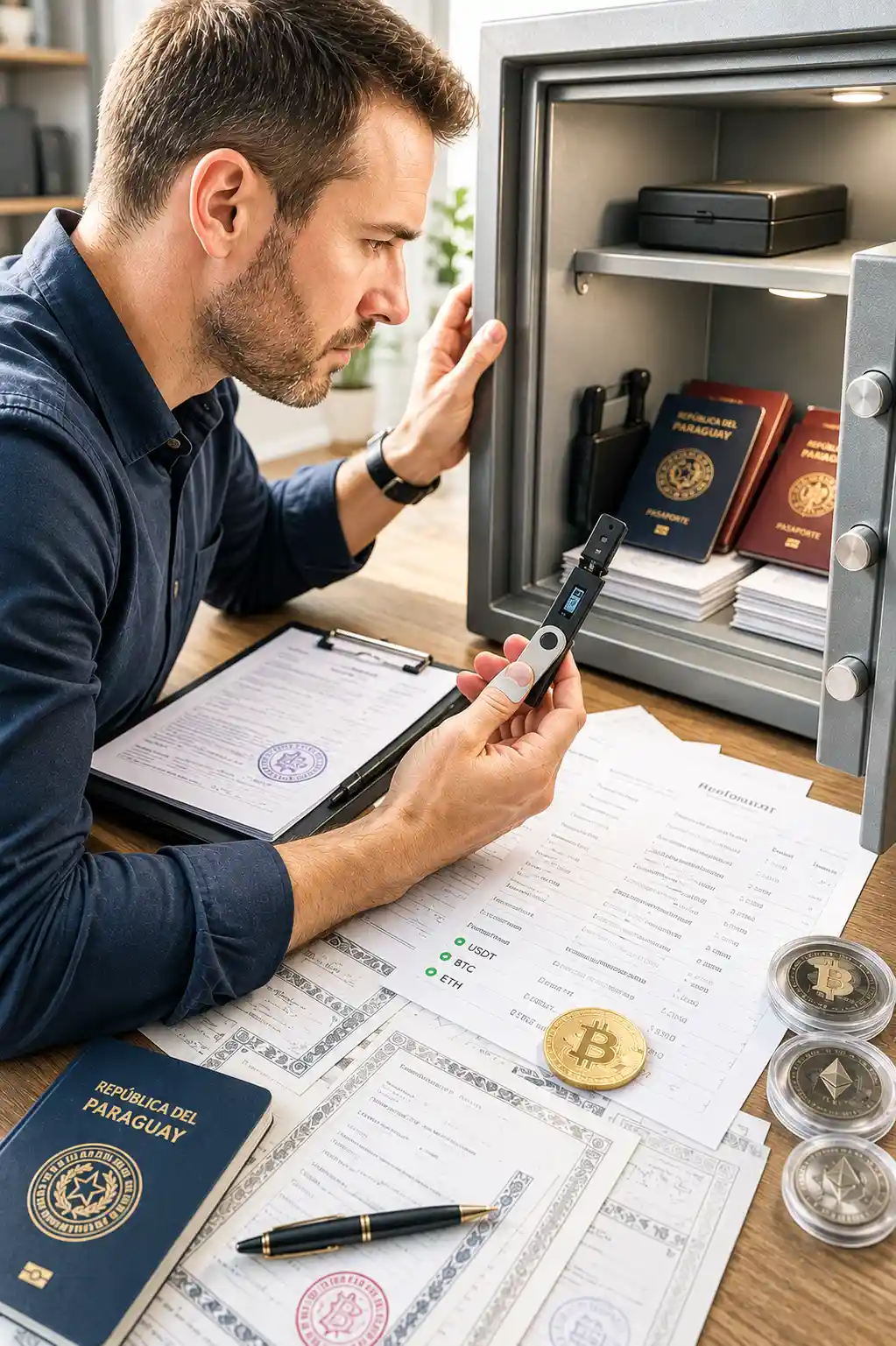
The residency changes do not stand alone. Additional documentation requirements in the crypto sector also show that Paraguay is placing greater emphasis on traceability, proof of origin and formal oversight.
The pattern is similar: the goal is less about banning certain activities entirely. What matters is that assets, income and transactions can be documented more clearly and explained when necessary.
This matters to applicants because many people considered Paraguay not only for its residency program, but for the broader environment: limited bureaucracy, low regulatory density and a comparatively pragmatic approach to capital and international mobility.
That environment is gradually changing. Paraguay does not automatically become unattractive as a result, but its original advantage is becoming smaller. Anyone considering the country as a base or Plan B should therefore look not only at individual rules, but at the direction in which the system is moving.

The changes in Paraguay should not be viewed in isolation. They are part of a development that can now be observed in several traditional relocation destinations and territorial-tax countries.
Panama has also shown the direction of travel with the now enacted Law 641. Tax advantages and residence rights are increasingly being linked to economic activity, investment or other forms of local connection. The days when a country could be used merely as a formal residence or tax residence are coming under increasing pressure.
This is the real significance of Resolution 407. The new requirements do not only change the process for permanent residency in Paraguay. They reflect a wider international trend: countries increasingly expect genuine substance rather than a formal presence on paper.
This does not mean that territorial tax systems will disappear. It does mean that many countries are examining more closely what genuine connection a person has to the country. Income, assets, economic activity and local ties are becoming increasingly important.
Anyone building an international structure today should therefore consider not only the current rules, but also the direction in which a country is developing. The central question is no longer only where taxes are low. It is increasingly important to understand under which conditions those advantages can be preserved over the long term.
Paraguay remains an interesting option. Recent developments show, however, that requirements are rising there as well. Anyone pursuing an international strategy should therefore act early and use existing options while they remain available.
Resolution 407 standardizes the requirements for proving financial solvency for permanent residency. Applicants will need to document more clearly how they support themselves and which evidence applies to their respective category.
Permanent residency will not necessarily become more difficult, but it will require significantly more documentation. For many applicants, the administrative workload will increase.
Not necessarily. Some categories explicitly require a RUC, the Paraguayan tax registration number, and Paraguayan tax documents, while others do not. Whether a RUC is required depends on the applicant category.
No. Based on the current rules, the resolution does not require Paraguayan-source income. The digital nomad category in particular typically involves foreign-source income.
This is currently one of the biggest open questions. The resolution no longer expressly lists savings as a separate category. Whether proof of assets alone will remain sufficient will depend on how the new rules are applied in practice.
Yes. Resolution 407 lists digital nomads as a separate category for proving financial solvency for permanent residency. Applicants must document employment, income and incoming payments.
Yes. Foreign documents must be apostilled or legalized. Certified translations into Spanish may also be required.
Yes. Resolution 407 does not change the fact that Paraguay remains a comparatively attractive residency option. The main change is the increasing documentation and administrative burden.
Last updated: June 8, 2026